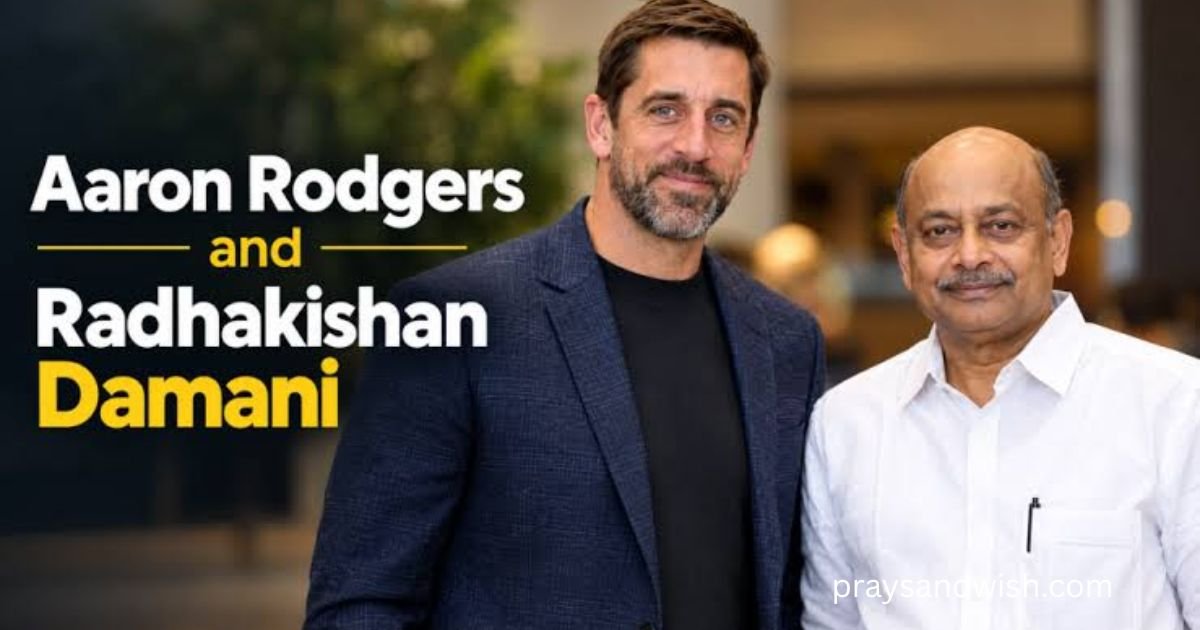
Aaron Rodgers and Radhakishan Damani come from remarkably different professional worlds, yet their careers offer an interesting opportunity to explore the many ways people build success. Rodgers is an accomplished American football quarterback known for his passing ability, competitive mindset, and years of high-profile performances in the National Football League (NFL). Damani is an Indian billionaire investor and entrepreneur best known for building Avenue Supermarts, the company behind the DMart retail chain.
At first glance, comparing Aaron Rodgers and Radhakishan Damani may seem unusual. One built his reputation on a football field, where performance is measured through games, championships, and individual statistics. The other developed his standing in the business world, where long-term investment decisions, operational discipline, and sustainable growth play central roles.
Their careers nevertheless raise similar questions about achievement, decision-making, risk, and longevity. Examining their professional journeys helps explain how success can emerge from very different environments—and why the principles behind it are not always as different as they appear.
Who Are Aaron Rodgers and Radhakishan Damani?
Before comparing their accomplishments, it helps to understand the backgrounds and professional identities of these two prominent figures.
Aaron Rodgers: An NFL Quarterback With a Distinctive Playing Style
Aaron Rodgers is an American professional football quarterback who became one of the defining players of his generation. He entered the NFL in 2005 after playing college football at the University of California, Berkeley.
Rodgers spent the majority of his career with the Green Bay Packers, developing a reputation for exceptional accuracy, quick decision-making, and the ability to deliver difficult passes under pressure. He won Super Bowl XLV with Green Bay following the 2010 season and was named the game’s Most Valuable Player.
His career has also included multiple NFL Most Valuable Player awards, making him one of the most decorated quarterbacks of the modern era. After leaving Green Bay, Rodgers joined the New York Jets, beginning a new chapter in a career that has attracted sustained attention from football fans and sports analysts.
Rodgers’ professional identity is closely associated with technical skill, preparation, adaptability, and the demands of performing in a highly competitive team sport.
Radhakishan Damani: The Investor Behind DMart
Radhakishan Damani is an Indian investor and entrepreneur whose reputation is built on value investing and organized retail. He founded Avenue Supermarts, the parent company of DMart, which operates a chain of value-focused supermarkets in India.
Damani initially established himself in the financial markets before expanding into retail. His business approach emphasizes affordability, efficient operations, careful cost management, and a model designed to encourage repeat purchases.
DMart’s appeal is based largely on offering everyday products at competitive prices. Its business model focuses on serving households with groceries, household essentials, personal care products, and other frequently purchased goods.
Unlike business personalities who cultivate a prominent public image, Damani is known for maintaining a relatively private profile. His reputation rests primarily on his investment history and the growth of his retail enterprise.
These different backgrounds provide the foundation for understanding why the two men are notable in their respective fields.
Aaron Rodgers and Radhakishan Damani: Comparing Their Career Achievements
The careers of Rodgers and Aaron Rodgers and Radhakishan Damani two distinct forms of professional accomplishment. Rodgers has achieved recognition through individual excellence and team competition, while Damani has built influence through investing and business ownership.
Achievements in Professional Football
Rodgers’ football achievements are closely connected to his ability to read defensive formations, anticipate openings, and make accurate throws under pressure. These skills helped him establish himself as a leading quarterback during his years with the Green Bay Packers.
Some of his most notable accomplishments include:
- Winning Super Bowl XLV with the Green Bay Packers.
- Earning Super Bowl MVP honors for his performance in that championship game.
- Winning multiple NFL MVP awards.
- Establishing a reputation for outstanding passing efficiency and ball security.
- Becoming one of the most recognizable quarterbacks of his generation.
These accomplishments reflect the importance of technical mastery in professional sports. A quarterback must combine physical execution with rapid analysis, communication, and the ability to adjust when a game does not unfold as expected.
Rodgers’ career also illustrates the challenges of maintaining excellence over time. Injuries, changes in coaching staff, evolving team strategies, and the physical demands of football can all influence a player’s performance and career trajectory.
Achievements in Investment and Retail
Damani’s achievements are measured differently. Rather than competing for championships, he has built wealth and influence through financial investments and the development of a retail business.
His most recognizable business achievement is DMart, which expanded from a retail venture into a major supermarket chain in India. Avenue Supermarts became publicly listed in 2017, giving investors an opportunity to participate in the company’s growth.
Damani’s business reputation is associated with several principles:
- Cost discipline: Keeping operating expenses under control is central to a value-oriented retail model.
- Competitive pricing: Offering attractive prices on everyday goods can encourage customer loyalty.
- Operational consistency: Standardized processes can help a retailer manage a growing network of stores.
- Long-term thinking: Building a durable business can require patience rather than chasing immediate popularity.
- Selective investment: Careful evaluation of business fundamentals can help investors identify opportunities while managing risk.
These principles help explain why Damani is frequently discussed in conversations about Indian entrepreneurship and value investing.
However, the growth of DMart should not be attributed to one individual alone. Retail expansion also depends on employees, suppliers, logistics, real estate decisions, customer demand, and broader economic conditions.
Leadership Styles: What Makes Their Approaches Different?
Leadership looks different in a professional sports organization than it does in a large retail company. Nevertheless, comparing the two careers reveals useful lessons about decision-making and accountability.
Aaron Rodgers and Leadership Under Pressure
A quarterback occupies one of the most demanding positions in American football. The player must process information quickly, communicate with teammates, and make decisions while facing defensive pressure.
Rodgers’ role requires a combination of preparation and improvisation. Studying opponents helps him recognize patterns, but a successful play can still depend on reacting to unexpected circumstances.
This environment highlights three leadership qualities.
First, preparation creates confidence. Understanding a playbook and anticipating defensive responses gives a quarterback more options when time is limited.
Second, communication matters. Even a technically gifted player depends on receivers, offensive linemen, coaches, and other teammates to execute a strategy.
Third, accountability is unavoidable. A quarterback’s decisions are frequently analyzed after every game, making performance evaluation an immediate and public part of the job.
These lessons apply beyond sports. Professionals in demanding roles often benefit from preparation, clear communication, and the willingness to evaluate their decisions honestly.
Radhakishan Damani and Leadership Through Business Systems
Damani’s professional environment rewards a different set of skills. A retailer cannot rely exclusively on one excellent decision or one successful day. It must deliver a consistent customer experience across locations and over extended periods.
A business model built around affordable everyday products requires careful coordination among purchasing, inventory management, staffing, store operations, and distribution.
Damani’s association with disciplined retail economics illustrates the importance of building systems that can operate consistently as a company expands.
For entrepreneurs, this offers a practical lesson: sustainable growth depends on repeatable processes, not just an appealing business idea.
A company may attract customers with low prices, but it must also manage costs, maintain product availability, and deliver reliable service. Weakness in any of these areas can undermine profitability.
The contrast between Rodgers and Damani is therefore not simply about sports versus business. It is about two different approaches to leadership: making high-pressure decisions in real time and creating systems that produce reliable results over the long term.
Risk Management: Football Decisions Versus Business Investments
Risk is an important part of both careers, although it takes different forms.
Managing Risk on the Football Field
In football, every play involves uncertainty. A quarterback may attempt a difficult pass that could produce a major gain but also carries the risk of an interception.
The decision depends on several factors, including the score, time remaining, defensive coverage, field position, and the team’s overall strategy.
A conservative decision may protect possession, while an aggressive choice may create a scoring opportunity. Neither approach is universally correct; the situation determines the potential value of the decision.
Rodgers’ career provides a useful example of why risk management requires more than avoiding mistakes. The objective is to make decisions that offer a favorable balance between potential rewards and possible consequences.
Managing Risk in Business and Investing
Damani operates in an environment where risk can develop gradually. Retail companies face changing consumer preferences, rising operating costs, competition, supply disruptions, and shifts in purchasing power.
Investors also face uncertainty about company valuations, economic conditions, and future earnings.
A disciplined investment approach generally involves examining business fundamentals, understanding the price paid for an asset, and recognizing that even promising investments can lose value.
Retail entrepreneurs must consider similar questions. Expanding into a new location may increase revenue, but it can also introduce additional expenses and operational complexity.
The common principle is straightforward: good risk management means understanding what can go wrong before committing resources.
For a quarterback, that may involve recognizing defensive coverage before releasing a pass. For a business owner, it may involve evaluating demand and operating costs before opening another store.
The settings differ, but both reward informed decisions rather than impulsive action.
What Their Careers Teach Us About Long-Term Success
The comparison between Aaron Rodgers and Radhakishan Damani also highlights how different professions define longevity.
Consistency Matters More Than a Single Achievement
Rodgers’ Super Bowl victory was a defining moment, but his broader reputation was built through years of performances across regular seasons and postseason games.
Similarly, DMart’s development cannot be explained by one successful store or a single investment decision. Building a large retail operation requires continued attention to pricing, costs, customer behavior, and execution.
In both cases, an important achievement may create visibility, but sustained performance helps establish a lasting reputation.
Adaptability Is Essential
Professional football changes as opponents develop new defensive strategies, coaching philosophies evolve, and players age. Quarterbacks must adjust their preparation and decision-making to remain effective.
Retail businesses face comparable pressures. Competitors change their prices, customers modify their spending habits, and operating expenses fluctuate.
A business that depends entirely on past success may struggle when conditions change. The same is true of an athlete who refuses to adjust to a different team, coach, or stage of a career.
Adaptability does not mean abandoning every established principle. It means preserving what works while responding intelligently to new circumstances.
Reputation Must Be Supported by Results
Rodgers’ public reputation is closely linked to measurable achievements, including awards and on-field performance. Damani’s reputation is associated with the development of a significant retail business and his history as an investor.
Their experiences illustrate an important distinction between visibility and accomplishment.
Public attention can increase awareness, but a durable professional reputation generally depends on evidence of ability, consistent execution, and results over time.
This lesson is relevant to entrepreneurs, employees, athletes, and anyone trying to develop credibility in a competitive field.
How Aaron Rodgers and Radhakishan Damani Influence Their Industries
Although they work in different countries and industries, both figures provide examples of how individual expertise can influence a broader professional environment.
Rodgers’ Influence on American Football
Rodgers is widely recognized for his passing ability, composure, and efficiency. His career is frequently discussed in comparisons involving elite quarterbacks and the development of modern passing offenses.
Quarterback evaluations involve more than championship totals. Analysts also consider accuracy, touchdown-to-interception performance, decision-making, durability, and effectiveness in different offensive systems.
Rodgers’ career offers material for discussions about these factors because it combines major achievements with the challenges of sustaining performance across changing circumstances.
His influence also extends to the business side of professional sports, where prominent players contribute to audience interest, media coverage, merchandise demand, and franchise visibility.
Damani’s Influence on Indian Retail
Damani’s influence is associated with organized retail and the economics of selling everyday goods at competitive prices.
DMart’s model has attracted attention because it emphasizes value, operational discipline, and the frequent-purchase categories that form part of household budgets.
The business also illustrates the challenges of scaling a retailer. Opening additional stores requires capital, suitable locations, inventory planning, distribution capacity, and an understanding of local demand.
For investors studying retail companies, the DMart story provides an example of why revenue growth alone is not enough to evaluate a business. Margins, capital requirements, store economics, and the ability to maintain customer demand are also important considerations.
Neither man’s professional journey offers a universal formula for success. Instead, their careers show how different combinations of expertise, execution, and strategic judgment can produce significant results.
Are Aaron Rodgers and Radhakishan Damani Connected?
There is no widely established professional connection between Aaron Rodgers and Radhakishan Damani. They are best understood as separate public figures whose careers happen to offer an interesting comparison.
Rodgers is associated with the NFL and American professional football, while Damani is associated with Indian investing and the DMart retail business.
A search for their names together may reflect curiosity about wealthy public figures, comparisons of professional success, or interest in individuals who have achieved prominence in different fields. However, the appearance of two names in the same search query does not establish a personal relationship, business partnership, or shared investment.
Readers should distinguish between a comparative discussion of two people and a verified report of an actual connection. Any claim that they have worked together or share a business interest would require reliable supporting evidence.
Frequently Asked Questions
1. Who is Aaron Rodgers?
Aaron Rodgers is an American football quarterback best known for his long tenure with the Green Bay Packers, his Super Bowl XLV victory, and his multiple NFL MVP awards. He later joined the New York Jets.
2. Who is Radhakishan Damani?
Radhakishan Damani is an Indian billionaire investor and entrepreneur known for founding Avenue Supermarts, the company that operates DMart supermarkets. He is recognized for his investment background and disciplined retail business model.
3. Are Aaron Rodgers and Radhakishan Damani related?
There is no widely established evidence that Aaron Rodgers and Radhakishan Damani are related. They are prominent figures from different professional backgrounds.
4. Do Aaron Rodgers and Radhakishan Damani work in the same industry?
No. Rodgers works in professional American football, while Damani is known for investing and retail entrepreneurship in India.
5. What is Aaron Rodgers famous for?
Rodgers is famous for his passing accuracy, decision-making, Super Bowl victory, and multiple NFL MVP awards. His career with the Green Bay Packers established him as one of the notable quarterbacks of his generation.
6. What is Radhakishan Damani famous for?
Damani is best known for his role in establishing DMart and building a successful retail business through Avenue Supermarts. He is also recognized for his history as an investor in Indian financial markets.
7. Who is richer, Aaron Rodgers or Radhakishan Damani?
Radhakishan Damani is substantially wealthier based on publicly reported billionaire wealth estimates. His fortune is associated with his business and investment holdings, while Rodgers’ wealth comes primarily from his professional football earnings, endorsements, and related activities. Exact net worth figures fluctuate and should be checked against current, reliable financial reporting.
8. What can entrepreneurs learn from Radhakishan Damani?
Entrepreneurs can study Damani’s emphasis on cost discipline, competitive pricing, operational consistency, and long-term business development. These principles can be useful in retail and other businesses, although success depends on market conditions and execution.
9. What can business professionals learn from Aaron Rodgers?
Rodgers’ career highlights the value of preparation, rapid decision-making, communication, and adaptability under pressure. These qualities can be applied to leadership and other demanding professional environments.
10. Why are Aaron Rodgers and Radhakishan Damani compared?
A comparison can help illustrate different approaches to achievement, risk management, leadership, and long-term success. However, the two are not commonly linked through a shared professional relationship; the comparison is analytical rather than evidence of a direct connection.
Conclusion
Aaron Rodgers and Radhakishan Damani represent two very different models of professional achievement. Rodgers built his reputation through elite quarterback play, championship success, and years of competition in the NFL. Damani established his standing through investing and the development of a major value-focused retail business in India.
Their careers reveal several common themes: preparation, disciplined decision-making, adaptability, and the importance of consistent execution. At the same time, their experiences demonstrate that success depends on understanding the demands of a particular field rather than applying a single strategy everywhere.
For sports fans, Rodgers offers a compelling example of performance under pressure. For entrepreneurs and investors, Damani provides a case study in retail economics and long-term business development. Looking at both careers together shows that professional success can take many forms, with different paths leading to lasting influence in their respective industries.