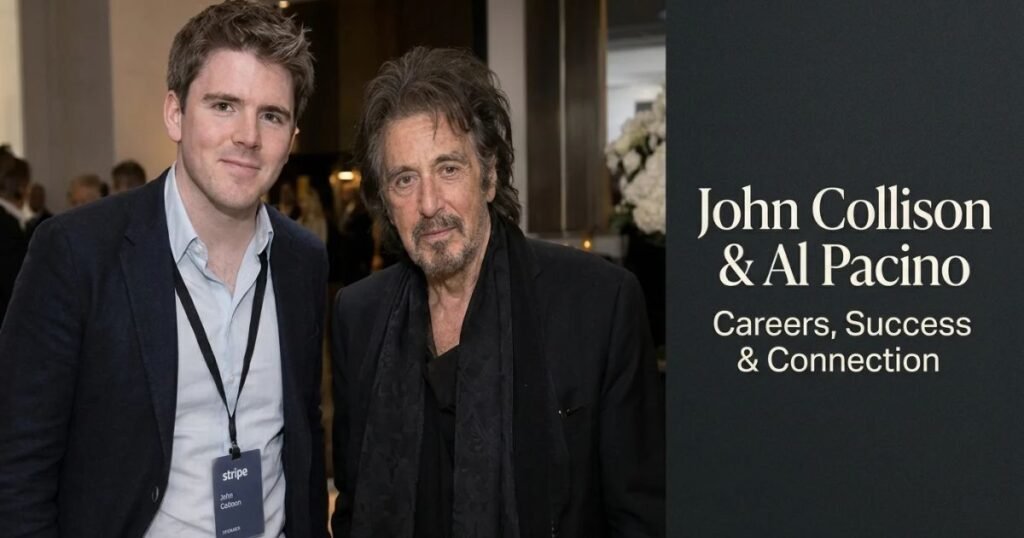
The worlds of financial technology and consumer goods may seem far apart, but both depend on a similar foundation: understanding customers, adapting to change, and building organizations that can compete in evolving markets. John Collison and Miguel Patricio offer an interesting comparison because their careers reflect two distinct approaches to these challenges.
Collison is best known as the co-founder of Stripe, a financial technology company that helps businesses accept payments and manage parts of their online commerce infrastructure. Patricio is known for his international leadership career in the food and beverage industry, including his tenure as chief executive officer of Kraft Heinz.
Although they operate in different business environments, their professional experiences raise valuable questions about innovation, leadership, technology, and long-term growth. What does it take to build a technology company that serves businesses around the world? How does an established consumer goods company respond to changing shopping habits, competitive pressures, and shifting customer preferences?
Understanding John Collison and Miguel Patricio provides a useful way to examine these questions without assuming that success in one industry follows the same formula as success in another.
Who Is John Collison?
John Collison is an Irish entrepreneur and the co-founder of Stripe, a financial technology company established in 2010 with his brother, Patrick Collison. Stripe develops infrastructure that enables businesses to accept online payments and manage a range of financial operations through software.
Collison’s career illustrates how technical problem-solving can become the foundation of a large commercial enterprise. Rather than operating as a traditional bank or a consumer-facing retailer, Stripe provides tools that other businesses use to run their own operations.
This business-to-business model places Stripe in a particularly important position within the digital economy. An online retailer, subscription service, software company, or international marketplace may need reliable payment processing even though payments are not the primary product it sells.
Stripe’s role is to help make those transactions possible.
How Stripe Changed the Online Payments Experience
Before modern payment platforms became widely accessible, integrating online payments could require considerable technical work. Businesses often had to coordinate with multiple financial institutions, payment processors, and software providers.
Stripe helped simplify this process by offering developer-oriented tools and application programming interfaces. These tools allow companies to integrate payment functionality into websites, applications, and other digital products.
The broader significance is not limited to convenience. Easier access to payment infrastructure can help smaller businesses launch online, allow software companies to introduce subscription services, and support international commerce.
For entrepreneurs, this kind of infrastructure can reduce the amount of time spent building supporting systems from scratch. Developers can concentrate more heavily on the product or service their customers actually want.
Entrepreneurship and Technical Problem-Solving
Collison’s entrepreneurial approach reflects a broader trend in technology: building infrastructure that solves difficult problems for other businesses.
Infrastructure companies may not always be visible to consumers, but their services can influence how entire industries operate. Payment processing is one example, alongside cloud computing, cybersecurity, logistics software, and digital identity systems.
This model also creates significant responsibilities. Payment providers must address security, reliability, regulatory requirements, fraud prevention, and the needs of businesses operating across different markets.
For a company such as Stripe, innovation therefore involves more than introducing new features. It also requires maintaining dependable systems and adapting to the increasingly complex demands of global commerce.
Who Is Miguel Patricio?
Miguel Patricio is a Portuguese business executive whose career has centered on global consumer brands, marketing strategy, and corporate leadership. He became widely recognized in the United States through his role as CEO of Kraft Heinz, serving from 2019 through 2023.
Before joining Kraft Heinz, Patricio spent many years in the beverage and consumer products industries, particularly at AB InBev and its predecessor organizations. His experience included international management positions and senior marketing responsibilities across multiple regions. Representatives of the Main Shareholders+1
His career offers a different perspective from Collison’s. While Collison helped build a technology platform from the ground up, Patricio developed his expertise in large organizations with established products, distribution networks, and globally recognized brands.
Miguel Patricio’s Leadership at Kraft Heinz
Kraft Heinz is associated with familiar food brands, including Heinz, Kraft, and Philadelphia. Its business depends on more than product recognition. The company must manage manufacturing, distribution, retailer relationships, pricing, product development, and consumer preferences across competitive markets.
When Patricio became CEO in 2019, he took on the challenge of guiding a major packaged-food company through a period of changing consumer expectations and business pressures.
His background in marketing and international management was relevant to this environment. Consumer goods companies need to understand why customers choose one product over another, how brands remain relevant, and how pricing decisions affect purchasing behavior.
These challenges become particularly complex when a company operates across different countries. Preferences, retail structures, regulations, and purchasing power vary from one market to another.
Patricio’s career demonstrates why global business leadership requires a combination of commercial judgment, brand management, and organizational coordination.
From CEO to Board Leadership
Patricio’s role at Kraft Heinz changed after his tenure as CEO ended in December 2023. He subsequently continued as board chair, a position he held through December 2025. AB InBev’s current board biography identifies him as a representative of its main shareholders and notes his continuing connection to the Kraft Heinz board. Representatives of the Main Shareholders+1
This distinction matters when comparing executive careers. A CEO typically leads day-to-day operations and implements company strategy, while a board chair helps oversee governance, executive accountability, and long-term direction.
The two roles require related but different skills. Effective board leadership involves evaluating management decisions, understanding business risks, and ensuring that strategic plans serve the company’s long-term interests.
John Collison and Miguel Patricio: Key Differences
Although John Collison and Miguel Patricio both have experience leading complex organizations, their careers represent different business models.
| Business dimension | John Collison | Miguel Patricio |
|---|---|---|
| Primary industry | Financial technology | Consumer goods and beverages |
| Best-known company connection | Stripe | Kraft Heinz |
| Core business challenge | Building and scaling financial infrastructure | Managing established brands and global operations |
| Main customer context | Businesses using digital financial tools | Consumers, retailers, and distribution partners |
| Professional emphasis | Entrepreneurship, technology, and product infrastructure | Marketing, international management, and corporate strategy |
| Leadership experience | Co-founder and president of a technology company | Former CEO and board leader in consumer goods |
These differences help explain why the two executives should not be evaluated using precisely the same criteria.
A technology platform may be judged by its reliability, developer experience, ability to support new business models, and capacity to expand into additional markets. A packaged-food company must also consider production costs, shelf placement, brand loyalty, product quality, and the economics of retail distribution.
Both require sound management, but the operational details are substantially different.
What Their Careers Reveal About Business Innovation
Innovation is often associated with startups and emerging technologies. However, it can also involve improving how established companies develop products, reach customers, and manage operations.
The careers of Collison and Patricio illustrate two useful forms of business innovation.
1. Building Infrastructure That Other Businesses Need
Stripe’s model shows how solving an operational problem for other companies can create a significant business opportunity.
Consider a small American software company that wants to sell monthly subscriptions. Its founders may understand their product exceptionally well, but payment processing, recurring billing, transaction security, and international payments can introduce considerable complexity.
A financial infrastructure provider can help manage some of these requirements, allowing the software company to focus on product development and customer acquisition.
The broader lesson is that business opportunities do not always come from selling directly to consumers. Sometimes, the more valuable opportunity is helping thousands of other companies operate more efficiently.
For entrepreneurs, this suggests several practical questions:
- Which business processes consume unnecessary time or resources?
- Can software simplify a problem that companies repeatedly encounter?
- Would customers pay for a solution that is more reliable or easier to integrate?
- Can the solution remain useful as customers grow?
These questions apply well beyond fintech, including accounting software, logistics, cloud infrastructure, and business automation.
2. Keeping Established Brands Relevant
Patricio’s career highlights another challenge: maintaining the competitiveness of businesses that already have substantial market recognition.
An established brand can have significant advantages, including customer familiarity, retail relationships, and distribution capacity. However, those advantages do not eliminate the need to adapt.
Consumers may change their preferences because of household budgets, dietary habits, new competitors, or shifts in shopping behavior. Retailers may also change how they allocate shelf space or negotiate with suppliers.
For a consumer goods company, innovation might involve adjusting product offerings, refining brand positioning, improving supply-chain efficiency, or reconsidering how products are marketed.
The practical lesson is that established businesses cannot rely exclusively on past success. They must continue to demonstrate relevance to current customers.
3. Matching Strategy to the Business Model
One of the most important lessons from comparing these executives is that there is no universal strategy for growth.
A startup may benefit from testing a product quickly, gathering feedback, and adjusting its features. A large food manufacturer must consider production capacity, inventory, food safety, distribution commitments, and the financial implications of changing a product line.
Applying startup methods without considering operational constraints can create problems. Likewise, expecting a young technology company to operate exactly like a mature consumer goods corporation can limit experimentation.
Successful leadership requires understanding which principles are universal and which practices depend on the specific business.
What Can Entrepreneurs Learn From John Collison and Miguel Patricio?
Entrepreneurs, managers, and business students can draw several practical lessons from these different career paths.
Focus on a Real Customer Problem
A business idea should begin with a clear understanding of the problem being solved.
For a technology entrepreneur, that might mean making a complicated financial process easier to integrate into an application. For a consumer brand, it could mean offering a product that meets customer expectations for taste, convenience, quality, or price.
A useful starting point is to speak with prospective customers, examine existing alternatives, and identify where current solutions fall short.
Understand the Economics Behind Growth
Revenue growth does not automatically mean a business is healthy.
Technology companies must account for development costs, infrastructure, security, customer support, and the resources required to maintain their platforms. Consumer goods companies must also manage raw materials, production, transportation, retailer terms, and marketing expenses.
Business leaders need to understand how these costs interact with pricing and demand.
For a small company, this can mean calculating whether each sale contributes enough to cover operating expenses. For a large organization, it may involve evaluating whether a growth strategy produces sustainable returns rather than simply increasing sales volume.
Balance Short-Term Results With Long-Term Investment
Companies face constant pressure to demonstrate progress. Yet some of the most important investments take time to produce results.
Technology businesses may need to invest in platform reliability and security before customers notice a direct benefit. Consumer goods companies may need sustained product development and brand investment to maintain customer loyalty.
Leaders must distinguish between spending that creates lasting value and spending that delivers little benefit.
This requires clear objectives, careful measurement, and a willingness to adjust when evidence suggests that a strategy is not working.
Treat International Expansion as More Than a Sales Opportunity
Both financial technology and consumer goods businesses encounter challenges when entering new markets.
A payment provider may need to address local payment preferences, financial regulations, and currency requirements. A consumer products company may need to adapt its offerings to local tastes, retail practices, and distribution systems.
Expanding internationally is therefore not simply a matter of translating a website or opening a sales office.
Businesses should evaluate regulatory requirements, customer behavior, local competition, and operational costs before committing significant resources to a new market.
Why Comparing Leaders From Different Industries Matters
Comparisons between executives often focus on wealth, company valuations, or public recognition. Those measures may attract attention, but they reveal only part of a leader’s professional contribution.
Examining John Collison and Miguel Patricio through their industries provides a more useful perspective.
Collison’s work at Stripe illustrates the role of technology infrastructure in enabling digital commerce. Patricio’s experience illustrates the complexity of managing consumer brands and large international organizations.
Their careers also show that leadership is shaped by the environment in which it takes place. A founder must help establish a company’s direction, develop its operating model, and build an organization capable of scaling. A senior executive in an established multinational must coordinate people, resources, and strategy across a complex existing business.
Neither environment is inherently easier. Each presents different demands and risks.
For students and professionals exploring business leadership, the comparison encourages a more thoughtful question: What skills does a particular organization need at its current stage of development?
That question is often more useful than asking which executive has the better leadership style in the abstract.
Frequently Asked Questions
1. Who are John Collison and Miguel Patricio?
John Collison is an Irish entrepreneur and the co-founder and president of Stripe, a financial technology company. Miguel Patricio is a Portuguese business executive known for his former role as CEO of Kraft Heinz and his international leadership experience in consumer goods and beverages.
2. What company did John Collison co-found?
John Collison co-founded Stripe with his brother, Patrick Collison, in 2010. Stripe provides financial technology and payment infrastructure for businesses operating online. Information and assets+1
3. What is Miguel Patricio known for?
Miguel Patricio is known for leading Kraft Heinz as CEO from 2019 to 2023 and for holding senior marketing and international management positions at AB InBev and related organizations. Representatives of the Main Shareholders+1
4. Do John Collison and Miguel Patricio work in the same industry?
No. Collison is associated John Collison and Miguel Patricio with financial technology and digital payments, while Patricio’s career has focused on consumer goods, beverages, marketing, and corporate management.
5. What is the main difference between Stripe and Kraft Heinz?
Stripe provides financial technology infrastructure that helps businesses manage online transactions and related operations. Kraft Heinz is a food and beverage company whose business involves branded products, manufacturing, distribution, and retail sales.
6. What leadership lessons can be learned from John Collison?
His entrepreneurial career illustrates the importance of identifying persistent business problems, developing scalable technology, and creating tools that allow other companies to operate more efficiently.
7. What leadership lessons can be learned from Miguel Patricio?
Patricio’s career highlights the importance of brand management, international business experience, customer understanding, and coordinating strategy across a large organization.
8. Why is Stripe relevant to American businesses?
Stripe provides payment and financial software that can help eligible businesses accept payments online and manage aspects of their commercial operations. Its tools are relevant to businesses ranging from startups to established enterprises. Information and assets+1
9. How does leadership differ between technology and consumer goods companies?
Technology leaders often focus on software development, product reliability, infrastructure, and the pace of innovation. Consumer goods leaders must also address manufacturing, distribution, product quality, brand positioning, and retailer relationships. Both need sound financial management and a clear understanding of customers.
10. What do these two executives have in common?
Both have worked in international business environments where long-term competitiveness depends on understanding customers, building effective organizations, and adapting to market changes. Their careers demonstrate different ways to pursue those goals.
Conclusion
John Collison and Miguel Patricio represent two distinct approaches to building and leading successful businesses. Collison’s work at Stripe highlights the importance of financial technology, scalable infrastructure, and solving operational problems for other companies. Patricio’s career demonstrates the demands of international management, brand development, and leadership within established consumer goods organizations.
Their experiences offer a broader lesson for entrepreneurs and business professionals: effective leadership depends on understanding the market, identifying what customers value, and choosing strategies suited to the organization’s needs.
Whether a company is developing digital payment tools or managing familiar products on grocery store shelves, lasting competitiveness requires more than a strong initial idea. It demands consistent execution, informed decision-making, and the ability to adapt as customer expectations and business conditions change.