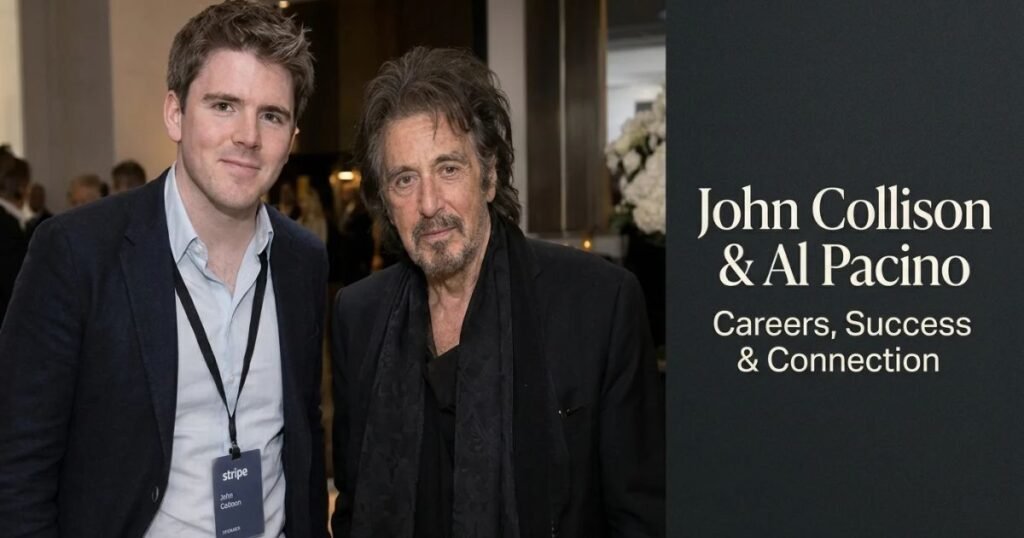
Success can take many forms. For some people, it means building a company that changes how businesses operate. For others, it means creating performances that remain memorable for generations. John Collison and Al Pacino represent these distinct paths, one rooted in financial technology and entrepreneurship, the other in acting and the history of American cinema.
Although their careers belong to very different industries, comparing the two offers an interesting perspective on ambition, professional discipline, creative problem-solving, and long-term influence. Collison helped build Stripe into a major payments technology company, while Pacino established himself as one of the most recognizable performers in film, television, and theater.
There is no established professional partnership or direct connection between the two figures that defines their public careers. Their relevance together comes from the broader question of how people create lasting value in fields that demand different skills, different forms of risk-taking, and different measures of success.
Understanding their backgrounds reveals why innovation does not follow a single formula and why professional achievement can look remarkably different across industries.
Who Is John Collison?
John Collison is an Irish entrepreneur best known as the co-founder and president of Stripe. He entered the technology industry at a young age and became known for helping develop tools that make online payments easier for businesses.
Stripe provides payment infrastructure for internet businesses, allowing companies to accept payments and manage related financial operations. Its technology supports a wide range of organizations, from small online retailers to large international enterprises.
Collison’s career illustrates how technical understanding, business judgment, and a focus on practical problems can combine to create a major company.
Early Life and Interest in Technology
John Collison was born in Ireland in 1990. He grew up alongside his brother Patrick Collison, who would later become his co-founder at Stripe.
Both brothers developed an early interest in computers and entrepreneurship. Before Stripe became a prominent name in financial technology, they worked on software businesses that introduced them to the challenges of building products, serving customers, and operating a growing company.
Their early experience helped establish a foundation for their later work. Rather than treating technology as an abstract subject, they approached it as a tool for solving concrete problems.
That approach became particularly relevant as online commerce expanded. Businesses increasingly needed reliable ways to accept digital payments, but the technical processes involved could be complicated and time-consuming.
Building Stripe and Simplifying Online Payments
Stripe was founded in 2010 by John and Patrick Collison. The company set out to make it easier for developers and businesses to integrate payment processing into websites and applications.
Historically, setting up online payments could involve multiple service providers, complicated documentation, and substantial technical work. Stripe focused on providing a more developer-friendly experience through software tools and payment infrastructure.
This focus addressed an important business need. Companies selling products or services online generally want to concentrate on their customers and core offerings rather than spend excessive time managing payment technology.
Stripe’s development demonstrates a broader principle of technology entrepreneurship: successful products often remove friction from activities that customers already need to perform.
Leadership Beyond the Startup Phase
Building a company is different from managing one as it grows. A startup may initially succeed through speed and experimentation, but a larger organization must also consider reliability, security, regulatory requirements, customer support, and international operations.
For a payments business, these responsibilities are particularly important because transactions involve sensitive financial information and customer trust.
Collison’s work at Stripe places him within a technology sector where infrastructure decisions can influence how businesses operate around the world. His career is therefore relevant not only to aspiring founders but also to people interested in software development, digital commerce, and the evolution of financial services.
Who Is Al Pacino?
Al Pacino is an American actor and filmmaker whose career has helped shape modern cinema. Known for his intense performances, distinctive screen presence, and ability to portray complicated characters, he became a defining figure in American film during the 1970s.
His work spans movies, theater, television, and directing. While many audiences associate him with crime dramas, his performances also explore ambition, morality, identity, loyalty, and personal conflict.
Pacino’s career provides a compelling example of how artistic skill, persistence, and a willingness to take creative risks can build a lasting professional reputation.
Early Life and Acting Education
Born Alfredo James Pacino on April 25, 1940, Pacino grew up in the South Bronx in New York City. His early life exposed him to the challenges of pursuing an artistic career without an easy path to financial security.
He studied acting and developed his skills through theater, eventually training at the Actors Studio under the influence of respected acting teachers, including Lee Strasberg. His commitment to performance developed through years of practice and work in stage productions before widespread film recognition arrived.
This background matters because Pacino’s success did not begin with instant celebrity. He spent years developing the craft that would later distinguish him from other performers.
The Breakthrough That Changed His Career
Pacino’s defining breakthrough came with The Godfather, released in 1972. He portrayed Michael Corleone, a character whose transformation from a reluctant participant in family affairs into a powerful crime boss became one of cinema’s most recognized character arcs.
The role required restraint as well as intensity. Instead of presenting Michael as openly aggressive from the beginning, Pacino conveyed the character’s gradual psychological transformation through subtle changes in expression, behavior, and delivery.
He returned to the role in The Godfather Part II and The Godfather Part III, further developing a character whose decisions carry consequences across decades.
His performance demonstrated that memorable acting often depends on what a character conceals as much as what the character says.
Films That Established His Legacy
Pacino’s filmography includes several influential works that illustrate his versatility.
- Serpico (1973) explored corruption and personal integrity through the story of a police officer.
- Dog Day Afternoon (1975) presented a tense crime drama centered on a bank robbery and the people caught in its aftermath.
- Scarface (1983) introduced audiences to his explosive portrayal of Tony Montana, a character whose ambition ultimately becomes destructive.
- Scent of a Woman (1992) earned Pacino the Academy Award for Best Actor for his portrayal of retired Army officer Frank Slade.
- Heat (1995) featured him opposite Robert De Niro in a celebrated crime thriller.
- The Irishman (2019) brought him into Martin Scorsese’s examination of organized crime, loyalty, and aging.
These performances helped establish Pacino as more than a recognizable movie star. They demonstrated his ability to move between contrasting personalities and stories while maintaining a distinctive acting style. The American Film Institute’s profile of Pacino highlights his lasting contributions to film and theater. American Film Institute+1
John Collison and Al Pacino: Comparing Two Different Careers
The comparison between John Collison and Al Pacino is most useful when viewed through their professional achievements rather than through an assumed personal relationship.
One works in a field where success depends on building reliable systems and helping businesses solve operational problems. The other works in an artistic industry where success depends on interpretation, communication, and the ability to connect with audiences.
Their careers reveal several important differences and similarities.
Innovation Versus Interpretation
Collison’s work involves identifying friction in digital commerce and helping develop technology that makes transactions easier. In financial technology, innovation often means improving systems that users may never consciously notice.
For example, an online retailer needs a payment process that customers can complete securely and conveniently. When that process works well, the technology supports the purchase without distracting from the shopping experience.
Pacino’s work involves a different form of problem-solving. An actor must interpret a script, understand a character’s motivations, collaborate with a director, and communicate emotions through performance.
In The Godfather, the gradual development of Michael Corleone required careful interpretation of character and story. The audience experiences the result through the performance rather than through an explanation of the acting process.
Both approaches involve understanding a problem and producing a result that matters to other people. The methods, however, are fundamentally different.
Building a Company Versus Building a Body of Work
A technology entrepreneur typically measures progress through product adoption, operational performance, customer relationships, and the ability to sustain a business over time.
For Collison, Stripe’s development provides a concrete example of building infrastructure that supports other organizations. The company’s work has implications for digital commerce, software development, and financial services.
An actor’s career develops through a different collection of achievements. Roles, performances, critical recognition, collaborations, and audience responses contribute to a professional legacy.
Pacino’s decades-long career illustrates how individual projects can build upon one another. A performance in one film may introduce an audience to an actor, while later performances expand that actor’s reputation and demonstrate new abilities.
Neither path guarantees lasting success. Companies must continue adapting to market conditions, while actors must navigate changing audiences, creative opportunities, and the realities of an evolving entertainment industry.
Risk-Taking and Long-Term Commitment
Entrepreneurship involves uncertainty. A founder may invest years in a product before knowing whether customers will adopt it or whether the business model will remain viable.
The technology sector also changes quickly. Companies must respond to new competitors, changing customer expectations, security challenges, and evolving regulations.
Acting involves its own risks. A performer may accept an unconventional role, work on a project that receives little attention, or explore a character that challenges an established public image.
Pacino’s career includes a wide variety of roles, from restrained dramatic performances to highly expressive characters. That range has allowed him to explore different aspects of his craft over many decades.
The shared lesson is not that entrepreneurs and actors face identical challenges. It is that both careers require decisions under uncertainty and a willingness to continue working when outcomes are not guaranteed.
What Their Careers Reveal About Modern Success
The stories of John Collison and Al Pacino offer useful lessons for people interested in business, technology, entertainment, and professional development.
Solve a Problem That Matters
A promising business often begins by addressing a problem that customers already experience. Stripe’s focus on simplifying online payments illustrates the value of reducing complexity in an essential business process.
The same principle can be applied to many industries. A business owner might improve how customers book appointments, a developer might simplify an existing workflow, or a service provider might make a confusing process easier to understand.
The important question is whether the solution provides genuine value rather than simply adding another product to the market.
Develop Skills Before Chasing Recognition
Pacino’s early years in theater and acting education show the importance of developing professional skills before widespread recognition arrives.
The equivalent principle applies in technology. Understanding software, customer needs, business operations, and security can provide a stronger foundation than pursuing publicity or rapid growth alone.
For someone starting a career, this means prioritizing practice, feedback, and measurable improvement.
Recognition may follow, but it is difficult to sustain without the underlying ability to deliver quality work.
Understand the Audience
An entrepreneur must understand what customers need and how they evaluate a product. An actor must understand the audience’s experience of a character and a story.
These are not interchangeable tasks, but both depend on looking beyond personal preferences.
A founder who builds a product solely around personal enthusiasm may overlook customer requirements. Similarly, an actor who focuses only on displaying emotion may fail to communicate the character’s motivations convincingly.
Understanding the intended audience helps professionals make better decisions about how to present their work.
Adapt Without Losing Direction
Long-term careers require change. Technology businesses must evolve as products, regulations, and customer expectations shift. Performers must navigate changes in storytelling, production methods, and the kinds of roles available to them.
Adaptation does not necessarily mean abandoning a core identity. It can mean finding new ways to apply established strengths to changing circumstances.
For entrepreneurs, that may involve improving a product while maintaining its central purpose. For actors, it may mean exploring new genres or working in different formats without abandoning the discipline that made earlier performances successful.
Why People May Search for John Collison and Al Pacino Together
The keyword “john collison and al pacino” does not inherently establish that the two men have worked together, share a business venture, or have a personal relationship.
People may search for two public figures together for several reasons. They might be exploring the backgrounds of successful people, comparing professional achievements, researching public figures mentioned in the same context, or investigating a possible connection they encountered online.
The distinction between a shared search query and a verified relationship is important.
John Collison is publicly associated with Stripe and financial technology. Al Pacino is publicly associated with acting, filmmaking, and major works of American cinema. Their documented careers offer clear subjects for comparison, but the similarities discussed here concern professional themes rather than a confirmed direct association.
Readers researching a possible collaboration or connection should look for reliable reporting, official announcements, or statements from the individuals involved. A shared mention in an article, search result, or social media post is not sufficient evidence of a relationship.
This approach helps readers distinguish useful biographical information from speculation.
Frequently Asked Questions
1. Who is John Collison?
John Collison is an Irish entrepreneur and the co-founder and president of Stripe, a financial technology company that provides payment infrastructure for businesses operating online. He co-founded the company with his brother Patrick Collison in 2010. Information and assets+1
2. Who is Al Pacino?
Al Pacino is an American actor and filmmaker known for major roles in The Godfather, Scarface, Dog Day Afternoon, and Scent of a Woman. His career includes film, television, and theater, and he won the Academy Award for Best Actor for Scent of a Woman. American Film Institute+1
3. Are John Collison and Al Pacino related?
There is no widely documented public evidence establishing a family relationship between John Collison and Al Pacino. Their public biographies describe different backgrounds and professional careers.
4. Have John Collison and Al Pacino worked together?
There is no widely documented collaboration between the two in their principal professional fields. Collison is known for his work in financial technology, while Pacino is known for acting and filmmaking.
5. What is John Collison best known for?
Collison is best known for co-founding Stripe, which helps businesses accept payments and manage online financial transactions. His work is associated with making payment infrastructure more accessible to software developers and businesses.
6. What is Al Pacino’s most famous role?
One of Pacino’s most famous roles is Michael Corleone in The Godfather film series. His portrayal of Tony Montana in Scarface is also widely recognized in popular culture.
7. What awards has Al Pacino won?
Pacino has won an Academy Award, two Primetime Emmy Awards, and two Tony Awards, among other honors. His recognition spans film, television, and theater. Penguin Random House+1
8. What can entrepreneurs learn from John Collison?
Entrepreneurs can study Collison’s career to understand the importance of solving practical problems, developing useful technology, considering customer needs, and building systems that can support a growing business.
9. What can professionals learn from Al Pacino’s career?
Pacino’s career illustrates the value of sustained practice, professional training, creative exploration, and a long-term commitment to improving one’s craft. His work also demonstrates how different roles can expand an established professional identity.
10. Why are John Collison and Al Pacino compared?
They can be compared as examples of achievement in different fields. Collison represents technology entrepreneurship and digital infrastructure, while Pacino represents artistic performance and cinematic influence. The comparison is about professional development and legacy, not an established personal or business connection.
Conclusion
John Collison and Al Pacino demonstrate that meaningful professional achievement can emerge from very different ambitions. Collison helped build technology that supports online businesses, while Pacino developed a body of acting work that continues to influence audiences and performers.
Their careers are not defined by a documented partnership, but examining them side by side offers a useful perspective on innovation, discipline, adaptability, and lasting influence.
For aspiring entrepreneurs, Collison’s career highlights the importance of solving practical problems and creating products that serve real needs. For aspiring performers and other creative professionals, Pacino’s journey illustrates the value of training, persistence, and continually developing one’s abilities.
Ultimately, success does not have a single definition. Whether someone builds a company or creates memorable performances, long-term achievement depends on delivering value, developing expertise, and continuing to adapt as opportunities and challenges change.